Plant-based cat food used to be a fringe idea. Now it pops up in pet stores, Instagram feeds, and vet waiting rooms. People ask about it for real reasons: ethics, food allergies, and concerns about the environmental cost of meat.
Still, a label that says “vegan” or “plant-based” doesn’t tell you whether a food is safe. Cats aren’t small dogs, and they aren’t flexible eaters. They’re built for animal prey, which means nutrition details matter more than the philosophy.
This guide lays out the vet-style basics: why veterinarians are cautious, which nutrients can’t be “optional,” what current research does and doesn’t show, and how to judge whether a plant-based cat food is actually complete. If you decide to try it anyway, you’ll also get a practical plan for switching and monitoring your cat without guessing.
Why vets are cautious: cats are obligate carnivores, not flexible eaters
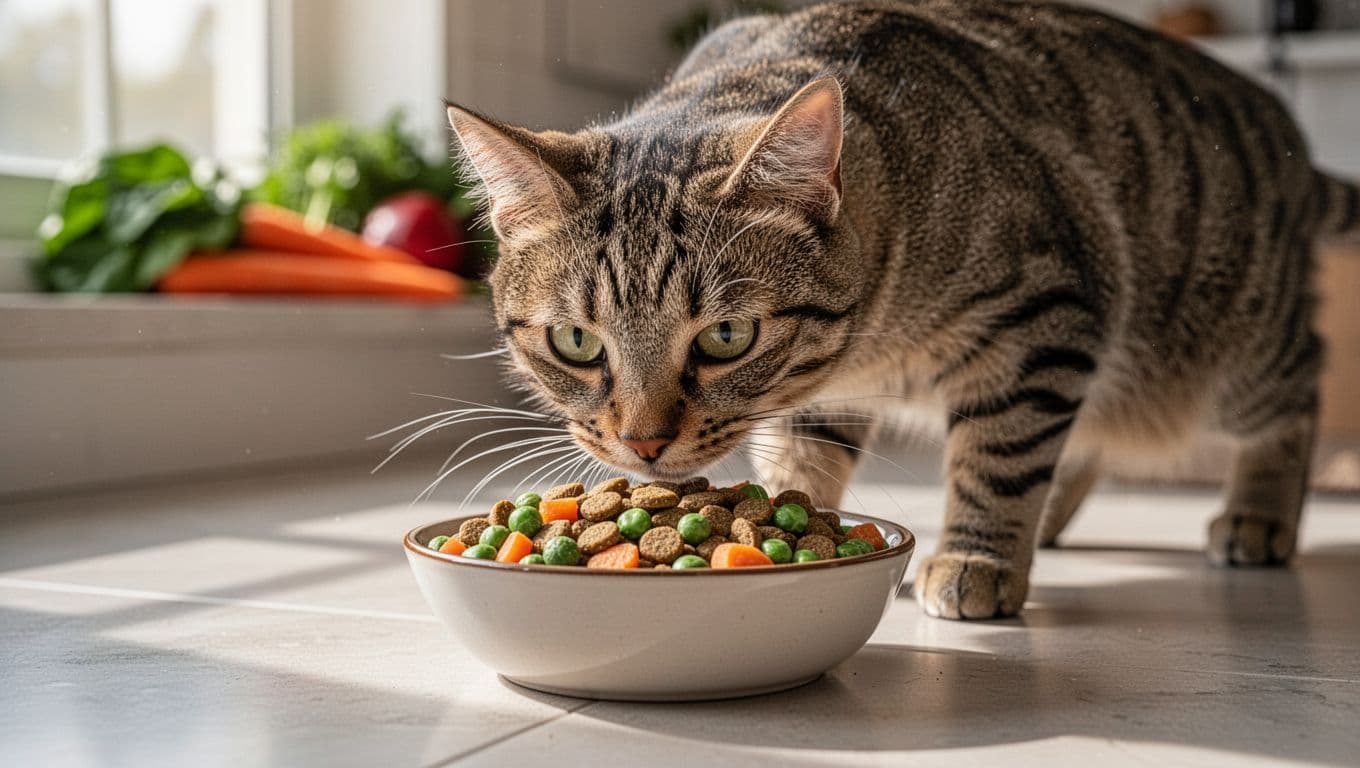
Cat inspecting a plant-based kibble bowl at home, created with AI.
“Obligate carnivore” sounds like jargon, but the meaning is simple: cats need specific nutrients that naturally come from animal tissue. They can’t make enough of certain compounds on their own. In other words, a cat can’t thrive on “good intentions” plus vegetables the way some other species can.
That biology shows up in everyday health outcomes. When key nutrients are missing, problems can build quietly for months. By the time you notice weight loss, coat changes, or less play, the issue can already be serious.
In 2026, vets aren’t speaking with one voice on vegan cat food. Some say it can work if (and only if) the diet is complete, balanced, and consistently eaten. Others still recommend meat-based diets as the safer default, mainly because long-term controlled studies are limited, and the downside of mistakes is high. A cat’s diet is like the foundation of a house. If it’s off by a little, the cracks may not show right away.
For a solid baseline on what cats need from any diet, Cornell’s feline nutrition guidance is a good refresher: Cornell Feline Health Center’s feeding basics.
The nutrients cats cannot miss (and why plant diets can fall short)
When vets worry about plant-based cat food, they aren’t talking about “protein” in a vague way. They’re thinking about specific nutrients and whether the cat can absorb and use them.
Here are the big ones that can’t be treated like optional add-ons:
- Taurine: Cats can’t make enough taurine. If intake is too low, the risk includes heart disease (dilated cardiomyopathy), vision problems, and reproductive issues. Even if a formula lists taurine, the amount and stability matter. Heat processing and storage can change what’s available. For signs and risks, see PetMD’s taurine deficiency overview.
- Arachidonic acid: This fatty acid supports skin, coat, and normal body functions. Cats don’t convert plant fats into enough arachidonic acid.
- Preformed vitamin A (retinol): Many animals convert beta-carotene into vitamin A. Cats don’t do this well, so they need preformed vitamin A in the diet.
- B vitamins (especially niacin and B6): Cats have higher needs for some B vitamins because of how they process protein. If levels drift low, appetite, skin, and energy can suffer.
- Highly digestible protein and the right amino acids: A bag can show a high protein percentage, yet still fall short on essential amino acids or digestibility. Cats need usable building blocks, not just a number on the label.
If a food is missing even one of these, it’s not “mostly okay.” Over time, it can become a medical problem.
What the latest research suggests, and what it does not prove yet
A lot of the strongest recent discussion comes from large owner-reported surveys. One widely cited 2023 paper in PLOS One (Andrew Knight and colleagues) reported that cats fed vegan diets had similar, and sometimes better, guardian-reported health measures compared with meat-fed cats, after adjusting for demographic factors. You can read the full printable paper here: PLOS One study on vegan versus meat-based cat food.
That sounds encouraging, and it may be. However, surveys have limits. Owners may choose different diets for different reasons, and reporting can be imperfect. Also, “vegan diet” in a survey often means a commercial product, not a homemade recipe. Those are not the same thing.
On the other side, earlier analyses of vegan pet foods found some products did not meet all nutrient requirements. That’s the core tension in 2026: well-formulated foods might work, but poorly formulated foods can fail in ways that aren’t obvious at first.
If you want a balanced, plain-language look at the uncertainty, this overview is helpful: The Conversation’s take on vegan cat diets. The practical takeaway is simple: don’t treat the category as “safe” or “unsafe.” Judge the specific food, and monitor the specific cat.
How to tell if a plant-based cat food is actually complete and safe
If you’re standing in a store aisle, your cat can’t read the ingredient list. You have to do the safety checks for them.
The goal is not to find a food that “sounds clean.” The goal is to find one that meets recognized nutritional standards, has quality control, and gives you evidence, not vibes. This is where many well-meaning owners get tripped up by boutique marketing, influencer hype, or a single dramatic testimonial.
Start with this mindset: cats need nutrients, not ingredient purity. A plant-based cat food can only be as good as its formulation and testing.
For broader guidance on how veterinarians think about choosing cat food in general (before you narrow to plant-based), Texas A&M’s vet school overview is useful: Texas A&M guide to choosing cat food.
Label checks that matter: AAFCO statement, life stage, and feeding trials
These label details matter more than “grain-free,” “human-grade,” or a pretty photo of peas.
- Look for the AAFCO nutritional adequacy statement. In the US, reputable cat foods usually state that the product is complete and balanced for a specific life stage based on AAFCO nutrient profiles, or that it passed AAFCO feeding trials.
AAFCO also explains how “purpose statements” and nutritional adequacy claims are supposed to work. The language is technical, but the point is clear: labels must be specific. Here’s the reference many manufacturers use: AAFCO guidance on nutritional adequacy claims (April 2025).
- Match the life stage. Kittens, pregnant cats, and nursing cats have different needs than adult cats. “All life stages” can be appropriate, but it also raises the bar for nutrient density. If your cat is a kitten, don’t settle for “adult maintenance.”
- Prefer feeding trials when available. “Formulated to meet” means the recipe was designed to hit targets on paper. Feeding trials mean real animals ate the food under controlled conditions. Trials don’t guarantee perfection, but they reduce guesswork.
A quick way to think about it:
| Claim type on label | What it usually means | Why it matters |
|---|---|---|
| “Animal feeding tests using AAFCO procedures…” | The food was tested in a feeding trial | Stronger real-world signal |
| “Formulated to meet AAFCO…” | Nutrients were calculated to meet profiles | Relies more on formulation and quality control |
After you find a product that clears these checks, take one more step: look at the company’s transparency. Can they share a full nutrient analysis (not just “guaranteed analysis”)? Do they have a qualified formulator on staff? Do they answer questions quickly and clearly?
Red flags vets see: homemade recipes, “supplement powder fixes,” and vague claims
Plant-based cat food becomes risky fast when it turns into a DIY project. Cats aren’t forgiving of small, repeated errors.
Vets commonly worry when they see:
- Homemade vegan recipes from the internet: Even well-written recipes often miss critical nutrients or underestimate how much a cat actually eats. Measurement drift happens, too.
- “Just add this supplement powder” plans: A single powder rarely solves everything, especially for amino acids, fatty acids, and vitamin balance. Mixing errors and selective eating can still wreck the math.
- No clear taurine strategy: “Naturally occurring taurine” and “plant taurine” claims should raise your eyebrows. Taurine is typically supplemented in pet foods for a reason.
- Vague adequacy language: If the label doesn’t clearly say complete and balanced for cats, treat it like a treat, not a meal.
- Extreme health promises: Be wary of foods that claim to prevent disease, cure allergies, or replace veterinary care. Nutrition can support health, but it’s not magic.
A simple gut-check helps: if a brand can’t explain its formulation and testing in plain English, it probably can’t protect your cat from long-term gaps.
For a clear explanation of why many animal welfare groups still caution against vegan feeding for cats, see: ASPCA on why cats can’t be vegan.
If you still want to try it, do it the way a vet would
Some cats do fine on a properly formulated plant-based diet. Others won’t touch it, or they’ll develop issues that need a quick course correction. The safest approach is controlled and boring. That’s a compliment.
Before switching, think about your cat’s “risk level.” Kittens, seniors, pregnant cats, and cats with kidney disease, heart disease, or urinary issues should not be switched casually. These cats need a direct plan with your veterinarian, and sometimes the answer is simply “don’t switch.”
If your cat is a stable adult and your vet agrees a trial is reasonable, treat the change like you would any medical experiment. One variable at a time, careful tracking, and a plan to stop if the data looks bad.
A safe transition plan and what to monitor at home
Switching too fast is the easiest way to cause vomiting, diarrhea, or a hunger strike.
A typical transition takes 7 to 14 days:
- Days 1 to 3: 75% old food, 25% new food
- Days 4 to 6: 50% old, 50% new
- Days 7 to 9: 25% old, 75% new
- Day 10 onward: 100% new food (only if all is going well)
Meanwhile, keep the rest of life steady. Don’t introduce new treats, new litter, or new routines during the switch.
At home, watch these basics daily:
- Appetite and enthusiasm at meals
- Weight (weekly is fine, daily is better for small cats)
- Energy and play
- Stool consistency and frequency
- Vomiting (even “hairballs” can increase during diet changes)
- Coat shine and dandruff
- Water intake and litter box habits
Stop the transition and call your vet if your cat won’t eat for 24 hours, vomits repeatedly, has diarrhea that lasts more than 24 to 48 hours, or loses weight.
Vet check-ins and tests that can catch problems early
If you’re choosing plant-based cat food for ethical reasons, it’s tempting to avoid “medicalizing” the decision. Still, monitoring is what makes the choice safer.
Talk with your veterinarian before the switch. If possible, ask for a referral to a board-certified veterinary nutritionist, especially if your cat has a medical condition.
A practical monitoring plan often includes:
- Baseline weight and body condition score, then recheck in 4 to 6 weeks
- Basic bloodwork, so you have a starting point and can spot trends
- Urinalysis, since urine pH and crystals matter for cats, and plant-based diets can shift urine chemistry
- Recheck timing, often again around 3 months if you stay on the diet
If your cat has a history of urinary problems, take this part seriously. It’s better to catch a urine issue early than to deal with pain, blockage risk, or emergency care later.
Conclusion: Put your cat’s biology first, always
Plant-based cat food isn’t automatically harmful, and it isn’t automatically safe. Cats have non-negotiable nutrient needs, and the margin for error is small. A plant-based diet only has a chance of working when it’s complete and tested, and when your cat reliably eats it.
If you’re considering the switch, choose evidence over ideology. Check for clear AAFCO adequacy language, match the right life stage, and avoid DIY recipes. Then monitor your cat like you would if a vet prescribed a new diet, because that’s essentially what you’re doing.
Your cat doesn’t care about the label. They care about feeling good every day, and that’s the priority.